- Node Mode
- Posts
- Every Single User is a Loyalty Contract in The Making
Every Single User is a Loyalty Contract in The Making
Why Trust is Built Through Actions, Not Promises

Aydıncan Ataberk
August 24, 2025
Hey everyone 👨🎨
Welcome to this Sunday’s essay!
↓ Level 1: Every new user first tries to figure out whether they can trust you or not.
↓ Level 2: This trust isn't built by launching perfect products; instead, it's earned by how you deliver and keep your word over time.
↓ Level 3: Users don't seek perfect products—they seek long-term partnerships, even with their flaws.
Companies think they're in what's called the "market"—a vague game whose actual meaning is debatable—with the products and services they develop. I think they're actually in the business of mutual loyalty contracts with people. Every single interaction, every single action builds an invisible contract, and product developers try to prove to user-humans that they've earned the loyalty owed in return for the contract.
I want to explain the topic with 3 examples. Two are comeback stories from failure, and the last one is about building trust from scratch. My third example is also the story of a software that triggered me to write this piece (in a good way). I'll try to discuss the topic around these examples.
No Man's Lie
First example: a universe simulation called No Man's Sky. Released in 2016 by Hello Games, an extremely modest British game studio, the game has achieved massive commercial success, selling over 10 million copies and bringing its creators $128 million in revenue just last year. But the game's entire lifespan hasn't been as successful as these numbers suggest. In fact, it wouldn't be wrong to say that Hello Games pulled off one of Steam's most disastrous launches in 2016.
Hello Games, a studio that had previously developed just a couple of small mobile games, announced in 2013 that they were creating a space game set in a procedurally generated universe. This meant creating a computer program containing billions of planets, stars, and life forms not by coding each one individually, but by programming physics laws, DNA, even chemistry and biology. This scenario meant an infinitely explorable game universe for players that would never become repetitive. At the same time, if it worked, it would be an incredible computational achievement. Players got so excited about the concept that it quickly became the talk of the entire gaming world—in forums and behind-the-scenes conversations everywhere. Sony, acting quickly at the time, acquired the publishing rights and provided financial support to Hello Games. This is exactly where things took a dangerous turn. At E3 2014, where the gaming world's biggest games and hardware are showcased, Hello Games founder Sean Murray's main stage presentation—backed by Sony's power—became the beginning of the great downfall. While Murray enthusiastically described the features I mentioned above on stage, he announced that the game would launch as multiplayer, that players could interact with each other and even have inter-clan conflicts, and that all planets would contain different life forms that even they didn't know about. The presentation would later become the subject of thousands of satirical videos and memes. Throughout the 2-3 years of development, Murray continued making vague but grand promises to players across various platforms.

One of many
The year 2016 arrived and the game was released. For those who don't know, as you can tell from the direction of this article, while the game had a basic procedural universe simulation, it was fundamentally very weak and none of the features Murray had been describing for 2 years existed. Especially regarding life forms, the program seemed like it had developed various limbs and organs that were randomized, rather than writing the code of life itself. The multiplayer turned out to be a complete lie. Murray tried to defend it for a while longer with vague interviews until he completely disappeared, then both Hello Games and Murray vanished entirely into silence. No Man's Sky quickly became Steam's most negatively reviewed product. And a comeback seemed impossible. Until it wasn't.
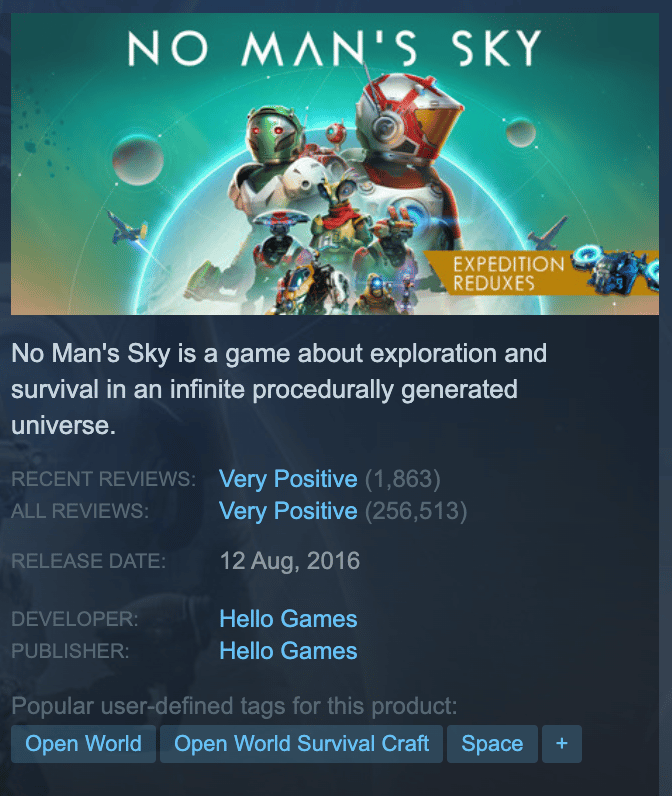
Nine full years have passed since then. Today No Man's Sky has 256,000 reviews on Steam and the cumulative total of all reviews is positive. I already gave you the sales figures at the beginning. How did these guys achieve this after the great collapse? With one simple thing: keeping their promises and continuously delivering. After the disastrous 2016 launch, Hello Games quietly began making updates. For 9 years. Continuously. Without asking for a single cent for any update or expansion pack, without making any other bold launches, they worked silently to fulfill the promise they had made. Over 9 years, No Man's Sky slowly began to reach and exceed what it had promised. In the first months, they were heavily criticized, partly because the gaming world can be extra toxic. But after a few years, players—paying customers—began saying, "Wait a minute, they had a rough start, but at least they're working and striving to stand behind their words," and they switched sides to support the team.
As a result, what could have been entered into business cases as a failure analysis of a product launch transformed into a case study of resilience, continuous development, and keeping one's word. Hello Games had actually made a rookie but huge mistake. However, they managed to perpetually earn back users' trust and turn 256,000 cumulative review scores positive.
A "Mapocalypse" by Design
It's not much discussed in the news (One of the Steve Job’s legacies), but Apple has had many failed product launches since the '90s. Over the years, these failures became more talked about because Apple became known for user-centricity and perfectionist product management philosophy, which raised expectations higher each time. In 2012, the company announced Apple Maps, and the service had a disastrous launch that caused real dramas for users. The service, full of serious bugs and glitches, had everything from showing cities in wrong locations to overlapping geographical shapes and incorrectly named regions. Moreover, there were cases and reports where users following Apple Maps found themselves stranded alone in deserts or ended up at wrong airports.
Tim Cook immediately took responsibility and announced in an apology statement that they were allowing all iPhone users to use Google Maps by default. As in the previous story, the comeback wouldn't be easy, but the team understood that mapping was an entirely different business and rolled up their sleeves for long-term work. Later, about the incident: "The first thing is that you're embarrassed," said Eddie Cue, head of software services at Apple. "Let's just deal with that one fact of emotion. I mean, these things mean a lot to us. We work really hard."
As an enthusiast of real printed atlases and a collector of all kinds of maps and map designs, I wasn't an Apple Maps user. In fact, there were times when I questioned the service's existence. I reconnected with Apple Maps in 2022 while making my TrackMaps app. In the app I developed for iPad OS, I needed to show the locations of racing tracks around the world on a map, and using Apple Maps within the iOS ecosystem was the most logical and easy solution.
When I first opened it, the design and colors blew me away. I was faced with a design that would satisfy a map enthusiast, with wonderful colors and typography choices that gave the feel of being printed on paper, evoking a sense of exploration rather than just function. It even reminded me of the Paris map that Galleries Lafayette printed in the '80s.

One of the best city map designs ever
Moreover, many features that weren't in the initial launch had now been continuously developed and added to the service. It seems the team really dedicated themselves to continuously developing and delivering the core service over the past 10 years (now 13 years) without stopping. According to Cue, learning from all mistakes and adopting a continuous delivery method over the years, they improved features one by one and presented them to users with constant updates.

It's difficult to access Google Maps and Apple Maps user and adoption figures, so it's hard to calculate how much financial success the approach brought. We can speculatively estimate that Apple brought its market share in maps to somewhere close to 20% as of 2025. US users have a big impact on this. But coming here from scratch, and moreover from a disastrous launch, is a significant success. When we look at user comments, just like in the example above, we see a service that improved over the years and slowly earned users' trust.
A Love Story With a Software Company
My last story isn't a comeback story, but essentially a story of building user trust through continuous delivery. Last year I found exactly the kind of 3D program I was looking for to develop an app I wanted to create. The software called Spline had the best export/release notes modal I'd ever seen in my life. How? The software team put all the export options that were on their feature roadmap for their MVP-level released application in the export modal, but the existing ones had checkmarks next to them while others said "Soon." The modal, of course, means nothing without a team that delivers behind it. Every week when I opened and used the application, I saw the export features that said "Soon" arriving one by one. They were developing so fast that I barely managed to capture a screenshot before the whole list was finished. But that's not the whole story.

Simple, yet so effective user communication
When I started developing my MediSoul app’s core with Spline, I encountered a major roadblock I hadn't anticipated. The 3D character I developed couldn't be controlled programmatically from within iOS. However, my roadmap, even my entire monetization model, was built on developable character and world features. Naturally, I did some research and when I accessed the documentation pages on the web, I saw "Live API for iOS coming soon!" written. But because I needed to release the app to make it to a hackathon, I had to release MediSoul with a lower MVP than I had dreamed of, just to ensure participation and to have shipped something. A technical note for those who are interested: I had to create separate 3D scenes for each character level progression (total workaround).
After waiting about a month, I appeared in the Spline Discord server asking "Any news on Code API for iOS?" Someone I guessed was a community manager said "soon, please keep following the release notes." After a while I asked again. Again he said "wait, we're working on it." I added the relevant help doc page to my bookmarks and started checking it once a month (yes, you can have obsessive users like me). I turned on notifications for Spline, which I follow on Twitter. This continued for about a year—I wasn't even aware it had been 1 year. Over the months, Spline released dozens of amazing features. I understood very well why some of these were prioritized. But there was no word from code API for iOS. Until the last day of this July.
I've waited for this for a long time! Thank you for delivering, @splinetool team.
Now I can continue developing my MediSoul app— aydincan (@Aydincan)
11:00 AM • Aug 1, 2025
That day, as usual, I opened Twitter, which I check once or twice a week. Ting! A notification from Spline. "We've launched our iOS Live API." What? Yes, exactly the feature I wanted had come, just as they promised. Out of curiosity, I went to the documentation page I had bookmarked. Boom. It had been updated and turned into a page explaining how this feature works. I opened Discord. Without needing to look at current notifications, I saw the message from my guy. I'm including it below.

❤️
This really is an incredible success. I applaud the Spline team. Not only did they deliver, but even the documentation page was instantly updated, and on top of that, they didn't forget me, a single user, and DM’d me. After these actions, I approve and sign the loyalty contract between the team and me until it's unilaterally broken.
Read and Agreed
When users register for a digital product for the first time or when a major update released, the purpose of the contracts they push ‘I Agree’ without actually reading is to protect the company against all situations. So even though the user says "I read and agreed," they didn't read the contract, nor can we say the contract is mutual. The real one is an invisible trust and loyalty contract signed at that very moment. The user, doing a great favor by allocating their time and attention to try the product they started, signs a contract where the product team is responsible for continous delivery. Unlike the user agreement that's approved without reading, the power of the invisible trust contract lies with the user. Every interaction either strengthens or weakens this invisible bond. The companies that understand this are earning the right to exist in users' lives, one kept promise at a time.
Tiny Challenge
Check out Apple Maps today and see what I mean.
Bright Minds
Quentin Tarantino
"I steal from every single movie ever made." Tarantino's loyalty contract with audiences is built on pure cinematic passion rather than formula. He promises films that feel like love letters to cinema itself, packed with references only true movie lovers catch. His approach: respect the audience's film knowledge and they'll follow you anywhere. Tarantino never dumbs down his work or chases trends—instead, he doubles down on what makes him unique, creating a cult-like loyalty that spans decades. I encourage you to watch this clip where hi discusses why true cinema is better then Netflix.
Time Capsule
The Newton MessagePad (1993)
Apple's first major mobile computing failure taught them that being first doesn't matter if you can't deliver on the core promise. The Newton's handwriting recognition was revolutionary in concept but frustrating in practice. This failure informed Apple's later approach with the iPhone: ship only when the experience actually works.
Node Mode [Off][ ]
Peace,
Aydıncan.
Reply